

Amazon S3 Vs Google Cloud Storage
A few months ago, Pics.io added Amazon S3 to the list of supported storages. And nosotros started to receive questions about whether it's worth moving from Google Bulldoze to AWS. Our clients have probably heard nearly the scalability and affordability of S3 storage. And so we weren't actually surprised by these questions.
And so we decided to help our readers to cull betwixt the two platforms. In the post, we covered both the pros and cons of Amazon S3 and Google Drive Storage. And nosotros also explained the basic differences between them.
Merely let's not exist hasty. Today's market of cloud calculating has a lot to offer but likewise many facets to consider. And since nosotros're going to compare the two largest vendors in this field, nosotros need to stay precise with what each platform offers us in terms of storage, functionality, security, ease of employ, pricing, etc., etc.
Requite Pics.io DAM a endeavor
Free 7-twenty-four hours trial
No credit card required
Set up in 3 minutes or less
A teensy scrap of backstory
Launched in afar 2006, Amazon S3 belongs to the Amazon Web Services (AWS) group. Without whatever exaggeration, S3 storage is called the first cloud computing storage. There was no analogy to S3 when it only entered the market. And first alternatives started to announced just in several years.
With its functionality and loftier scalability, Amazon S3 attracted many businesses. Plus, AWS is a subsidiary of Amazon - the largest on-demand cloud computing platform. And this worked in favor of S3 storage. So during the side by side six years, Amazon S3 completely dominated the market…
Until Google Drive joined the competition. Established by Google in 2012, GD challenged the assumptions around deject storage. With its fifteen GD of free space and ease of use, the company proved that any user can take reward of cloud computing. Access to the cyberspace is the merely condition here.
And then what about the difference betwixt the two storages?
Two storages equal two different principles
When it comes to contrasting Amazon S3 vs. GD, the first matter to know is the difference between file and object storage systems. Equally it's self-evident, the two storages work based on 2 different principles. And a user needs to sympathise the underlying concept of both to be able to cull the best storage.
To start with, Amazon S3 is object storage. This means that the storage manipulates data every bit distinct units chosen objects. They are structured in a apartment environment, with no specific organization or bureaucracy.
A single object is equanimous of files, plus their metadata. The file also has its unique name or identifying ID number, which helps a user to find & access information technology in the storage. And when y'all upload the file, whether it's a document, image, or video, it gets transformed and stored as an object:

Object = file + metadata (optionally)
In plow, more-usual-for-us Google Drive is file storage & synchronization service. In uncomplicated terms, it means that GD stores and organizes data in a hierarchy model. Information is "packed" in files, these are organized in folders, and folders are grouped under directories and subdirectories. Hither's how it looks like:
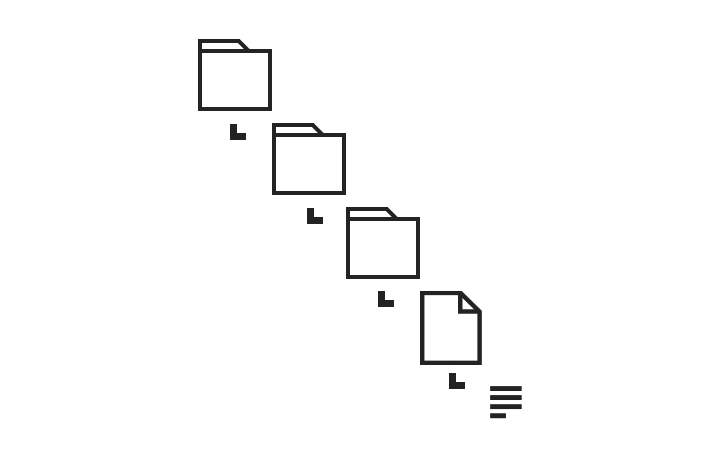
Directory > subdirectory > folder > file > data
So users clutter files in the system, uploading them from any device or virtual machine connected to it. And and then they read & recall information. You might be surprised, but file-level storage is relatively new, at least compared to object storage. So GD uses a so-called FUSE adapter to mount files from its buckets and then convert them into a file arrangement.
So which is better?
Now when we know the bones distinction between the two tools, we can shift to their benefits & drawbacks. Just we don't want to carp you lot with a never-ending list of pros and cons. Instead, if y'all don't heed, nosotros'll answer the key question that interests whatsoever GD or Amazon S3 users. Hither it goes...
Why is Amazon S3 better than GD?
There are many reasons why you should choose Amazon S3 over GD. Just we ignore its long-continuing commitment to cloud computing, and write about more than objective factors. Then these are the reasons why:
1) High scalability
In information technology, scalability means that the app or product continues to function well even with the change in its size or volume. In other words, the performance of Amazon S3 isn't affected when the number of your files grows. Even more, your S3 storage grows together with your materials.
2) Sectional durability
Durability is one more factor other storages cannot compete with Amazon S3. The storage was designed to provide 99,99% durability. And so no need to worry: the adventure of losing your information is reduced to nil.
3) Super-cheap prices
At commencement glance, AWS prices don't really differ from GD. Simply they're nevertheless more flexible due to the pay-as-you-go approach. What'southward more than, the storage is more than than affordable in the long run. Amazon S3 costs approximately $0.03 per GB. But the toll goes down with the more you store.
For this very reason, Amazon S3 is a top choice for many large corporations. Owning one thousand or even million assets, these businesses prefer AWS considering of its charges based on usage. And they just tin't afford GD, with its charges for every separate characteristic.
4) Variety of services
Amazon S3 is merely ane of many other services provided by Amazon. Birthday, AWS counts over 175 fully-fledged services. And this is why it has the reputation of the most mature, enterprise-level cloud provider.
And of course, Amazon S3 is uniform with this growing array of available services. For example, your team would enjoy easy app deployment provided by AWS. Or they can configure & manage the storage infrastructure if they need it. To put information technology another way, this diverseness of services contribute to more flexibility within the storage over again.
5) Versioning
If you lot're not going to transform your storage in a total mess, with files named Version1, Final23, Finalfinal11 cluttered all around the storage, version control is a must for yous. In brief, the tool allows you to retrieve older revisions and even deleted files. So you lot'll keep all your revisions in ane identify.
Actually, both Amazon S3 and GD support versioning. But when in S3, you lot tin can enable the tool completely free of charge, GD provides versioning at extra costs.
6) Automatic data migration
Another good news for those who want to shift from GD to Amazon S3! AWS offers yous many information migration options. Yous tin can complete this with rsync, S3 or Glacier command-line interface.
And so the moving process won't be then stressful for you. This is especially valuable if we're speaking about massive data transfers like 1000+ assets. And needless to say, automated data import/export volition save you fourth dimension & money resource.
And why is GD amend than Amazon S3?
But does Amazon S3 trounce GD in all criteria? Of course, no. For a reason, GD has so many supporters all around the globe, and we'll discuss these motives now:
i) 15 GB for free
For a large enterprise, fifteen GB of infinite is picayune to nothing. But it could be a practiced start (or at to the lowest degree a prissy bonus) for a startup or an individual user. Especially, if these 15 GB is gratuitous of accuse. It's always pleasant to become free stuff, isn't it?
2) Maximum file size
Not for nothing, they say that GD is the merely ideal storage for large data. Indeed, Amazon S3 may exist better for large information transfers. Just its potential for big data storage is much lower than in GD. Expressed in figures, five GB is the maximum file size in Amazon. But this counts for nothing if nosotros compare information technology to v TB maximum file size in GD.
three) The market share
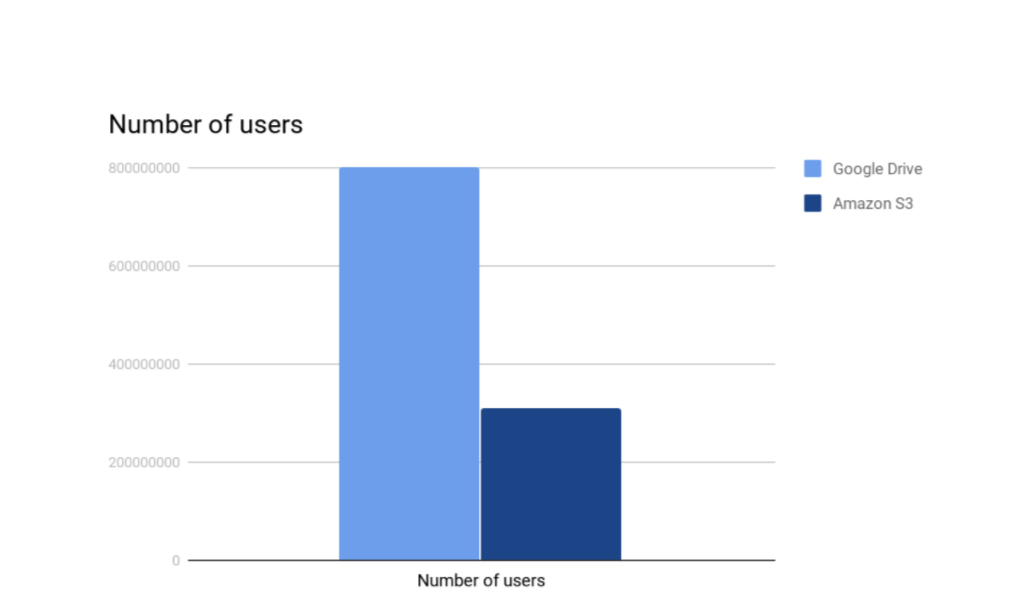
Amazon S3 is more available than GD. The storage covers 21 geographical locations compared to 20 zones covered by GD. Only this didn't affect the market share of GB, which overruns S3 storage about iii times when it comes to the number of actual users:
iv) Getting started with GD is much easier
As an quondam saying claims, yous never get a second risk to make a first impression. Indeed, the first impression matters even when you lot try a new tool. And information technology's likely your acquaintance with GD will be much more pleasant than with AWS.
Amazon S3 has a longer and more complicated signup process. For instance, you have no access to the storage until you create an AWS account, configure its management console, and figure out the difference between root vs. IAM users. Hither at Pics.io, we've written a detailed guide to help newcomers in Amazon S3. But still, it doesn't change the fact that Amazon S3 is not that like shooting fish in a barrel to get started.
And you cannot say the same thing about GD. In this case, yous merely set up a Google account (and yous probably accept one, right?) and beginning using the app.
On one more than critical divergence betwixt the tools, GD arranges its services by project rather than by account equally in AWS. So your teammates may piece of work on wholly dissever projects nether the same account.
5) User-friendly interface
This point is actually linked to the previous one. Indeed, it takes time to go used to the S3 web interface. All those keys, buckets, objects, etc. are confusing, especially to starting time-time users. And vice versa, the GD interface is very intuitive. With its UI/UX pattern, y'all admission the information easily and in no time.
6) Innovation
Both storages work considerably to keep upwardly to date. Withal, it's GD that is unremarkably the first to introduce high-tech innovations. Machine learning, information load balancing, powerful data analytics, AI, etc., etc. These are only a few high-end calculating solutions offered by GD, and the platform continues to develop.
7) Effortless public sharing
Again, public sharing is nowadays in GD and Amazon S3. But in GD, you create a publicly accessible URL and send it to whoever y'all need.
In Amazon S3, the aforementioned process volition take more than time and attempt. All uploaded materials in Amazon S3 are private by default. And and then you'll need to become to bucket settings and configure public permissions. This could be a fleck intimidating to some users.
What else about sharing, information technology'southward more secure in GD than in Amazon S3. In GD storage, data goes fully encrypted to be transmitted. AWS, in plow, uses a more than general format for data encryption.
8) Information memory
Retention is one more important feature available in GD and not found in S3. You just set the retention rule and retain all your files on a permanent footing. It'southward very useful when you lot need to know when the file was created or last modified, for case.
Some factors to exclude or what do GD & Amazon S3 have in mutual?
In some things, the ii storages are both good enough. And there is no significant deviation between them. In this case, simply ignore the post-obit factors when deciding between GD & Amazon S3:
1) Self-service
This is the core principle for many mod cloud storages. According to this idea, you come up to the storage, take what you demand, and leave. And then y'all don't bother your colleagues, waste matter time and efforts for redundant communication.
2) Unlimited storage
With GD & Amazon S3, yous forget about times when in that location was no space to fit all your materials. Y'all become as much storage space as you need (and ready to pay for).
3) Operation
Both tools have huge calculating (or the processing power) and brand efforts to improve their performance even ameliorate.
Amazon S3 is famous for its robust storage infrastructure, with a massive network all over the globe. For an extra price, users can increase/decrease their full storage capacity like size, ability, or memory.
With more pocket-sized infrastructure, GD withal makes up a good rival to Amazon S3 due to its innovation: load balancing, faster persistent disks, and then on. And this is why the estimated uploads of big files to GD is 4 times faster than to Amazon S3.
four) Security
You don't have to worry near security too, regardless of the storage you choose. Both Amazon S3 & GD offer strong security measures like land-of-the-art encryption, multi-cistron authentication, network firework, and others.
5) Fill-in
Similarly, none of the services will let you to lose your information in instance of some emergency or human error. The simplest way to backup your data in GD is to manually brand their copies and salvage these somewhere on an external bulldoze. But there are as well more than avant-garde solutions like Fill-in & Sync service.
In Amazon S3, you lot don't take a direct backup tool. But nonetheless, you may use AWS disaster recovery. In this fashion, your data gets automatically converted and so they load and run natively on AWS.
Whatsoever storage you choose, use DAM to manage your files the about effectively
As you run into, each storage has its own pros and cons. And your determination should be made exclusively based on your needs and preferences. But don't place severe expectations on Amazon S3 or GD.
They're simply storages and can't help you lot organize your files, admission them easily, or distribute in the most presentable way.
For all those purposes (and many more), nosotros have digital asset management. This is a top solution in today's market to manage large and small amounts of assets. Hither are a few ways how DAM will compliment your chosen storage:
- Discover & access your files in no time through keywords, locations, rates, content, etc.
- Organize your assets in the most prolific way, creating collections & subcollections;
- Become rid of duplicates with the easiest version control created past Pics.io;
- Share your materials with clients, partners, freelancers, etc. easily and in a sleek manner cheers to Pics.io public websites;
- Collaborate with your squad within your storage: go out comments, tag your colleagues, leave visual marks for them to highlight the surface area on a photo;
- Receive regular updates on whatever changes in your storage like what new materials were uploaded and who provided them;
- Integrate your DAM storage with almost any tool y'all demand, from Adobe Creative Cloud to Slack and Trello;
- Go to know how your assets are used or your team's productivity with bones analytical tools;
- Dorsum up your materials in case you mistakenly delete them.
Give Pics.io DAM a try
Gratuitous vii-mean solar day trial
No credit card required
Set upwardly in 3 minutes or less
Pics.io works on tiptop of your Google Bulldoze or Amazon S3. But in case y'all don't need to go into the trouble of setting upwardly storage or configuring permissions, consider adopting Pics.io equally an all-in-one DAM solution, with its own storage + DAM.
A few takeaways
From the factors we considered, Amazon S3 appears as a better solution for large corporations. Information technology'southward more flexible and compatible with other Amazon services. Your company volition love it for customization & depression prices, specially if y'all work with the bulk of files.
In contrast, Google Bulldoze is more suitable for small & startup businesses too as for private users. It's also expert for not-tech-savvy users thank you to its simple and intuitive interface. You receive innovative & high-productive concern storage for pocket-sized sums of money.
And any determination you brand, don't forget to add a simple and powerful DAM solution to it. Pics.io will let you to go beyond storing so y'all could organize, access, and distribute your materials most productively.
Source: https://blog.pics.io/amazon-s3-vs-google-cloud-storage/
Posted by: mckinneywhences.blogspot.com
0 Response to "Amazon S3 Vs Google Cloud Storage"
Post a Comment